Translating an Early-Stage Business Idea into a Tangible Product Vision
Many startup ideas fail not because they lack ambition, but because critical assumptions remain abstract. Investors are often asked to believe in a future product that exists only in presentations, projections, and founder conviction.
Kristal.AI (formerly O2O Technologies) faced this challenge during its early stages. The company set out to build a digital-first investment platform that would enable retail investors to access professionally managed portfolios while allowing licensed advisors to manage investments at scale.
The vision was compelling. The challenge was making it believable.
Executive Context
Kristal.AI (formerly O2O Technologies) was founded with a bold ambition: to build a transparent, digital-first investing platform that empowered retail investors while enabling licensed advisors to manage portfolios at scale. The founders needed a way to demonstrate that:
The business model could operate end-to-end
Investor and advisor workflows were viable
The platform could balance user simplicity with financial complexity
The concept could evolve into a scalable product
A traditional pitch deck was unlikely to answer these questions convincingly. To raise capital, they had to demonstrate that the business model, product logic, and user experience could hold up in the real world.
I was engagedMy to help transform an evolving business concept into a tangible product experience that could demonstrate how the platform would actually work before it was built.
Key Challenges
The project began with several layers of uncertainty:
Product features were still evolving
User journeys were largely inspired by industry examples and conceptual models
The risk was not simply product ambiguity. The greater risk was credibility.
The founders needed to demonstrate that they understood the realities of customer trust, investment management, and operational execution—not just the opportunity itself.
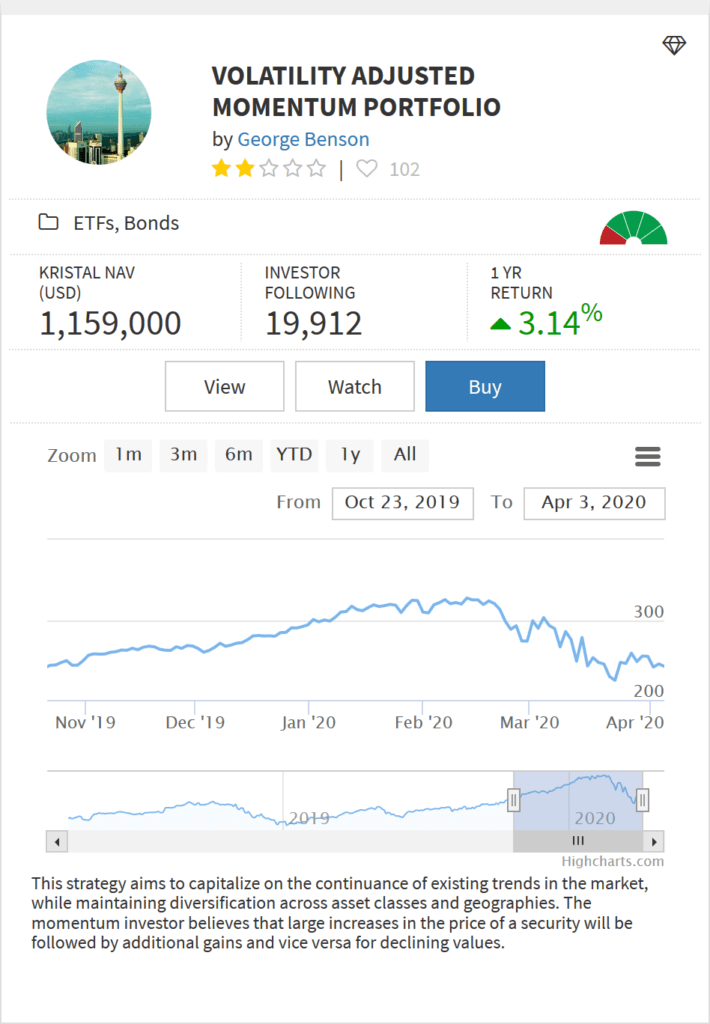
A central concept within the model was the KristalTM, a customized investment portfolio comprising combinations of assets such as stocks, ETFs, and gold, categorized by risk profiles to support different investor preferences.
Mapping these concepts early helped ensure that the product experience accurately reflected the business model rather than simply presenting a simplified visual interpretation of it.
Design Framing: From 'Pitching an Idea' to 'Demonstrating Readiness'
Default Approach
How do we explain this idea more effectively?
Suggested Approach
How might we allow investors to experience the business as though it already existed?
This reframing shifted the focus from presentation to demonstration.
Rather than creating materials that described the concept, the objective became building an experience that revealed how the business would function in practice.
The Approach
01. Making Business Assumptions Visible
Before designing interfaces, the work focused on understanding and structuring the underlying business logic.
Key areas included:
Core investment concepts
Advisor and investor relationships
Risk and transparency models
Compliance-related considerations
Critical decision points across the customer lifecycle
A central concept within the model was the KristalTM, a customized investment portfolio comprising combinations of assets such as stocks, ETFs, and gold, categorized by risk profiles to support different investor preferences.
Mapping these concepts early helped ensure that the product experience accurately reflected the business model rather than simply presenting a simplified visual interpretation of it.
KristalTM: A bunit of investment or strategy
About KristalTM
Each KristalTM represented a customised portfolio with several investments within, comprising a combination of gold, stocks, and ETFs
Each KristalTM was graded based on its market risk factor, allowing investors to choose KristalsTM that matched their risk appetite
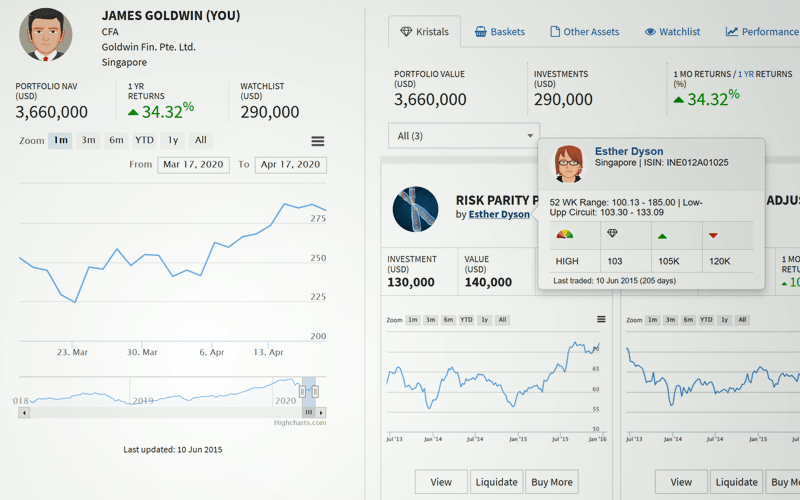
Individual investors could sign up and invest in KristalsTM of their choice, while advisors could create KristalTM and, with investor permission, manage their portfolios
02. Designing the Logic Before Designing the Interface
The project prioritized business workflows and decision-making over visual design.
I proposed and led the development of a fully navigable prototype that could simulate the end-to-end experience without requiring backend implementation.
The prototype was designed to:
Capture complete user journeys
Represent core platform behaviors
Validate business assumptions
Demonstrate product logic to investors
Serve as a foundation for future engineering discussions
The objective was not to create a pitch artifact. The objective was to make the proposed business operationally understandable.
03. Building Trust Through Consistency
As product workflows matured, a parallel effort focused on establishing the platform's visual identity and interaction language.
With no existing brand system in place, the experience needed to communicate confidence, clarity, and professionalism from the outset.
Brand and product design evolved together to create:
Consistent interactions
A coherent visual language
Clear communication patterns
A credible market-facing experience
In this context, brand design was not primarily about aesthetics. It functioned as a mechanism for reducing uncertainty and reinforcing trust.
Success & Outcome
Within approximately four months, the engagement transformed a largely conceptual proposition into a cohesive product experience that stakeholders could interact with directly.
The initiative delivered:
An investor-ready representation of the business model
End-to-end product workflows
Greater alignment between business, product, and future engineering considerations
Faster validation and iteration of key assumptions
A durable prototype that extended beyond fundraising activities
Most importantly, the company was able to move conversations beyond what the platform might become and toward evidence of how it could operate in practice.
Key Takeaway
For early-stage ventures, investors are rarely evaluating ideas alone.
They are evaluating whether a team can convert an idea into an executable system.
This engagement demonstrated how design can act as a bridge between business ambition and operational credibility. By making assumptions visible, workflows tangible, and product logic testable, the work helped transform an abstract concept into something stakeholders could understand, challenge, and ultimately believe in.
"We had this innovative product idea that could be a game-changer in the investment-tech industry.
We were looking for a digital design solution provider who could help us convert the idea into a visual form that we could take to our investors and stakeholders. Parag (from UIConnect) was referred to us by an industry acquaintance who had hired him in the past and was very happy with his design and consulting work.
...and engaged to help us with ideation, conceptualisation, design and UI-UX services for the production of our algorithm-based trading portal and the corporate branding of O2O Technologies."