Kubot entered a fast‑growing fintech market with a familiar playbook 'digital first investing, millennial targeting, and rapid expansion'. What followed raised a more fundamental question: where does real adoption actually come from?
This case traces how market evidence, rather than execution speed, reshaped strategic direction before product and positioning drifted too far from reality.
Background
Kubot (formerly SmartMoney.co) entered the Indian fintech market at a time when interest in mutual funds was growing, yet adoption remained hesitant and uneven. Several consumer‑facing platforms were beginning to normalize digital investing, but success was fragmented-driven as much by timing, trust, and positioning as by functionality.
Kubot’s ambition was clear: to enable online mutual fund investments for a broader audience. The uncertainty lay in who exactly to serve, where growth would come from, and how to differentiate meaningfully in an increasingly crowded space.
I was brought in to help Kubot pause execution and answer a more fundamental question: Was the business aiming at the right market, with the right assumptions, using the right story?
The Core Stategic Challenge
Kubot’s early strategy rested on plausible but unvalidated assumptions:
Mutual fund adoption would naturally accelerate among younger, urban, millennial investors.
Growth strategies used by visible players like ET Money or Fisdom could be replicated.
Expansion into B15 markets would unlock higher volumes and commissions.
The company lacked clarity on:
Where its most receptive users were actually located.
There was limited understanding of how investor behavior differed across regions and income profiles.
It was unclear which levers truly drove trust and conversion in mutual fund adoption.
Conducting field research at a national scale was impractical.
Continuing without clarity risked building the right product for the wrong audience.
Design Framing: From Assumptions to Evidence
Rather than immediately optimizing messaging or UX, I reframed the engagement as a decision‑validation exercise. The intent was not to confirm Kubot's direction but to challenge it with evidence. I led a structured secondary market research initiative to:
Understand the true size, dynamics, and maturity of the Indian mutual fund market.
Map investor sentiment, behavior patterns, and adoption barriers.
Identify which segments were genuinely underserved versus merely under-penetrated.
Deconstruct competitor growth—not by imitation, but by understanding why it worked.
This reframing shifted the role of design from delivery to strategic correction.
The Approach
01. Market & Behavioural Research as a Strategic Input
The research effort synthesised:
Industry outlook and regulatory context.
Investor demographics, habits, and psychological barriers.
Distributor and platform dynamics across traditional and digital channels.
Geographic spread of real investment intent versus assumed interest.
50 Pager research and insights on mutual fund market
About The Report
The key highlights of this secondary market research were:
The prevailing situation and future outlook of the investment and mutual fund industry in India, including investor sentiment.
The target audience analysis, covering demographics, investment habits, behavioral characteristics, and tapped versus untapped potential.
Competitive landscape assessment, including the roles of distributors (both traditional and tech-enabled) and key market data points.
Observations and insights derived from the analysis.
Recommendations focused on strategic direction and organic growth opportunities.
In short, the output was not a static report, but a decision lens used to evaluate Kubot’s existing assumptions and test alternative positioning paths.
02. Market & Behavioural Research as a Strategic Input
The findings pointed to a targeting problem rather than a product problem. I presented Kubot with an alternative positioning direction, initially counter‑intuitive, but grounded in data. This prompted:
A recalibration of the ideal customer profile.
Greater focus on segments where trust formation outweighed product complexity.
A clearer go-to-market narrative aligned to actual investor's interests.
This represented a strategic pivot, not a cosmetic adjustment.
03. Translating Insight into Product & Experience Direction
Once strategic clarity was established:
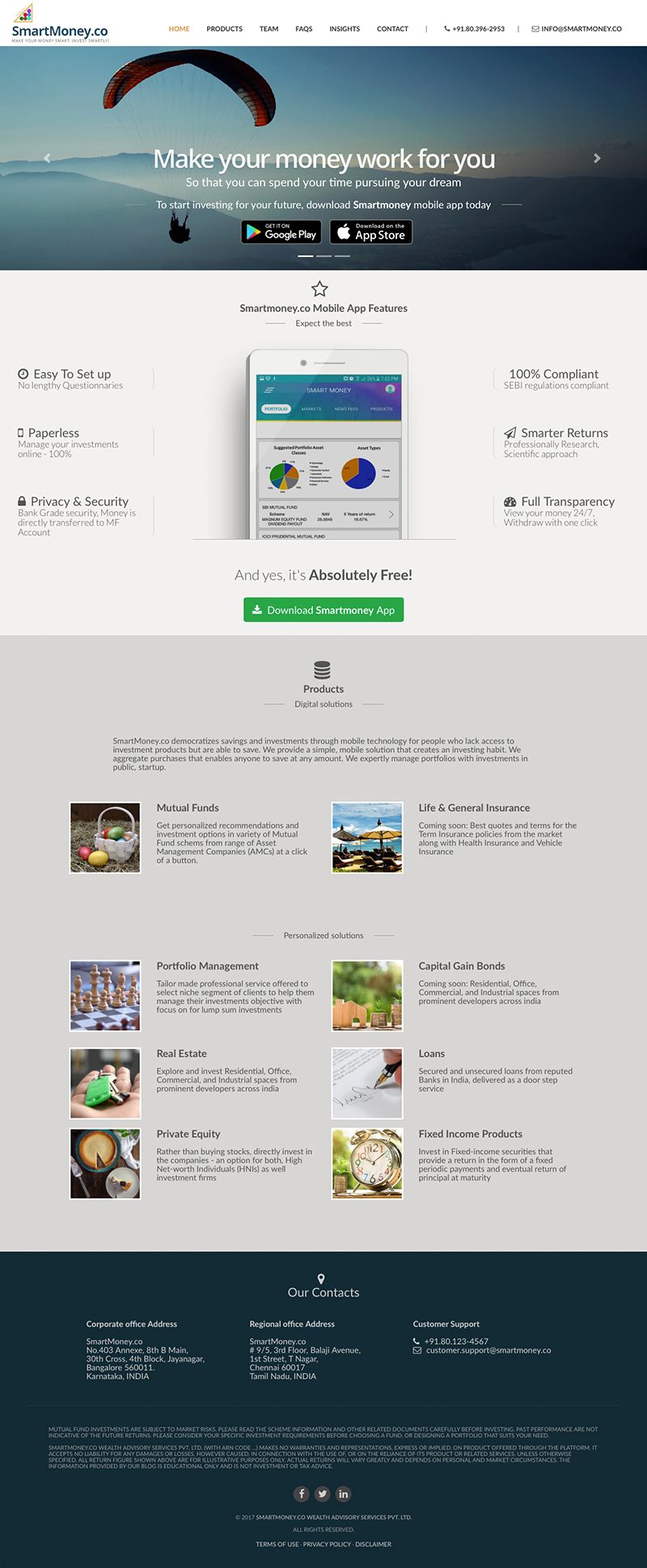
The corporate website was redesigned to communicate the refined proposition clearly.
Product website with new proposition based on the market research and insights
UX for the flagship mobile app was shaped around informed, confidence-building journeys rather than aspirational investing tropes.
Research insights were embedded into information architecture, onboarding flows, and content hierarchy.
Design here functioned as alignment, ensuring the product no longer worked against its own market reality.
Resulting Impact
Kubot gained clarity on where not to compete, saving in time and marketing cost.
Early traction improved through sharper targeting and messaging.
The revised UX was approved with minimal iteration, indicating stronger internal alignment.
Research insights influenced both digital touchpoints and future product planning.
Most importantly, the company moved forward with confidence in its direction, rather than momentum driven by assumption.
Deliverables
Market & Behavioral Research
Go-to-Market Strategy
Product Positioning
Mobile App UX
Website UX Strategy
Timeline
3 Months: From briefing to launch
Tools
WordpressElementorHubspotMicrosoft Power AutomateGoogle AnalyticsMicrosoft Team